

Release time:2023-11-09 Browsed0 order
Conkmile Customer Case Study | Smart Manufacturing | Industrial Asset Visibility | Colombia

Connecting People, Materials, and Critical Production Equipment for Unified Visibility Across Multiple Manufacturing Facilities.
At an approximately 8,000 m² industrial facility in Colombia, personnel, materials, and critical production equipment frequently move
between different factory buildings and operational areas.
Traditional manual management methods make it difficult to track asset locations and movements efficiently. Meanwhile, deploying a
large number of independently networked BLE gateways can significantly increase network infrastructure, installation, and maintenance costs.
To address these challenges, Conkmile provided a hybrid wireless hardware solution combining BLE Beacons with the DX-CP34
(BLE + LoRaWAN). This architecture integrates short-range identification with long-range wireless data backhaul, enabling the customer's
existing management system to achieve greater visibility across multiple factory buildings.


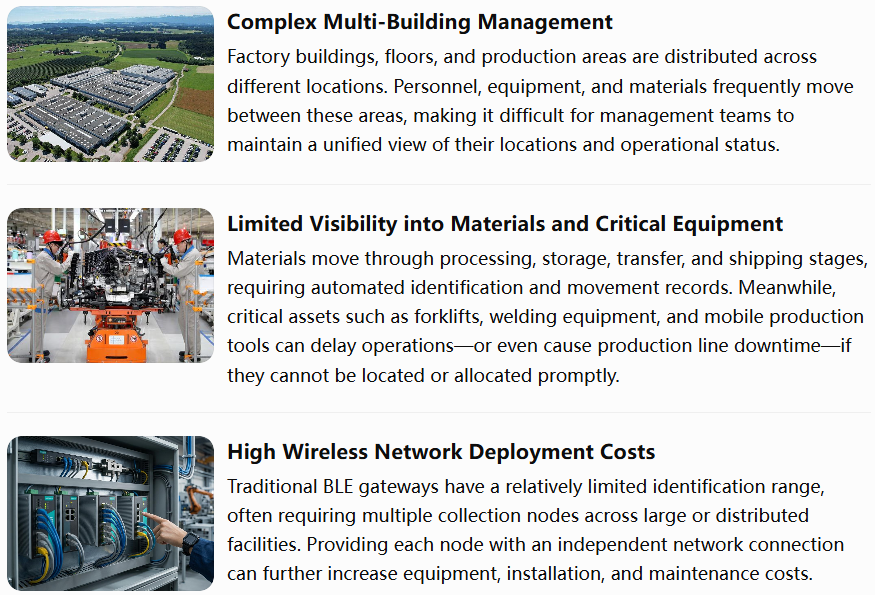
The customer's industrial facility consists of multiple production areas supporting raw material processing, manufacturing, material storage,
equipment operations, and finished goods dispatch.
During daily operations, materials pass through different production stages, while forklifts, mobile manufacturing equipment, and tools are
shared across various work areas.
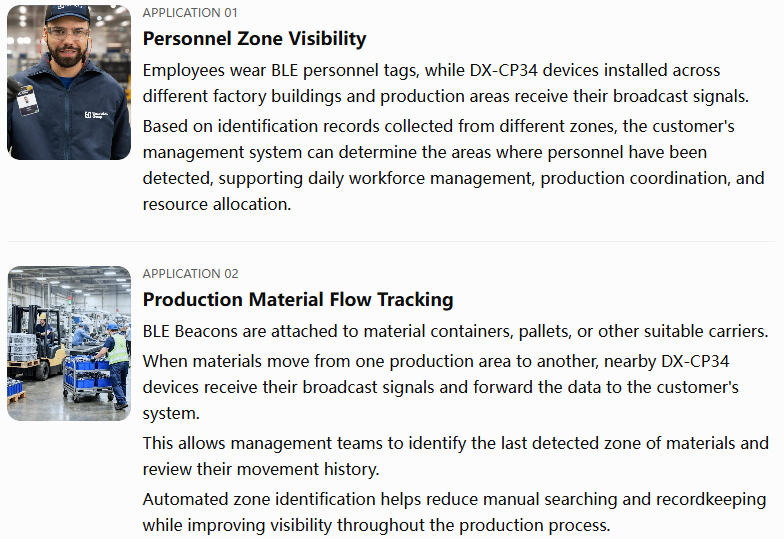
Management teams need timely visibility into personnel and equipment locations, material movements, and production and shipping progress.
Relying primarily on manual searches, recordkeeping, and on-site verification consumes valuable time and can lead to delayed information
updates, missing records, and coordination difficulties between departments.
To improve operational efficiency, the customer wanted to introduce wireless identification technology and integrate personnel, material,
and critical equipment data into its existing management platform.
The objective was to enable more efficient zone-level management and greater visibility throughout the manufacturing process.
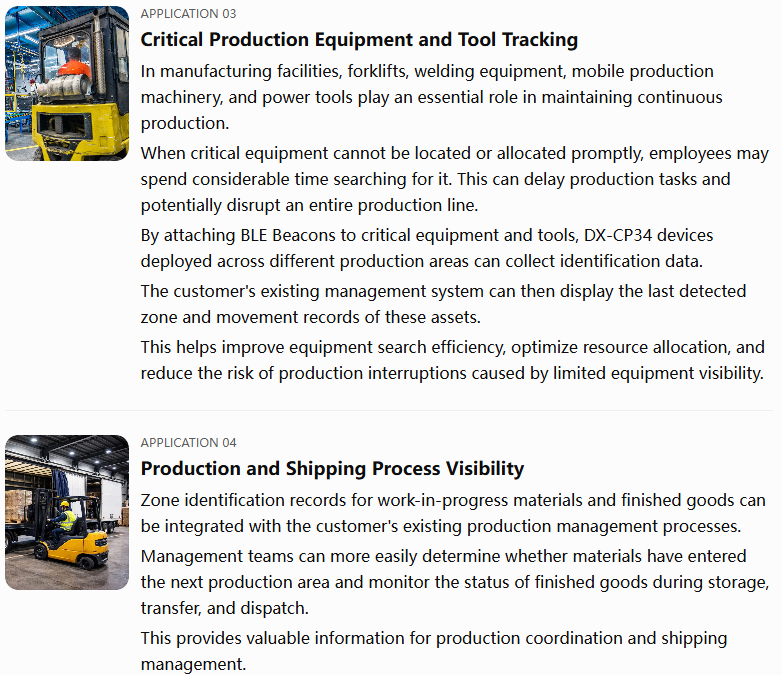
For this customer, the challenge extended beyond identifying personnel and materials. Critical production equipment also needed to be
located and allocated efficiently, while identification data from different factory buildings had to be transmitted to a unified
management system.
The customer therefore needed a wireless architecture capable of supporting distributed production areas while keeping network
infrastructure costs under control.
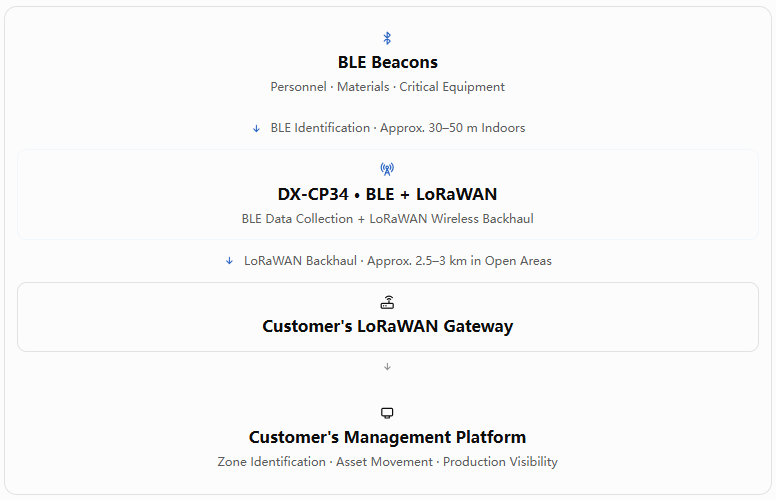
BLE for short-range identification. LoRaWAN for long-range wireless data backhaul.

Multi-building wireless deployment illustration: DX-CP34 devices are installed across different production areas, while personnel, materials,
and equipment carry BLE Beacons. Collected data is transmitted through LoRaWAN to the customer's management system.
The DX-CP34 integrates BLE reception and LoRaWAN communication into a single hardware device.
BLE Beacons attached to personnel, materials, and equipment periodically broadcast identification data.
Nearby DX-CP34 devices receive these broadcasts and transmit the collected information through LoRaWAN to the customer's own
LoRaWAN gateway, which forwards the data to the existing management platform.
4.2 Two Wireless Technologies, Complementary Advantages

For this Colombian customer, the main reason for selecting BLE + LoRaWAN was the need to establish a unified identification network
across multiple distributed factory buildings while controlling gateway deployment and network infrastructure costs.
Traditional network-connected BLE gateways have a relatively limited BLE identification range. Multiple collection nodes are generally
required across different buildings, floors, and production areas.
Each gateway also needs access to Ethernet, Wi-Fi, or cellular connectivity.
In areas without existing network infrastructure, adding more collection points may require additional network equipment, cabling,
installation, and maintenance.
By comparison, the DX-CP34 integrates BLE data collection and long-range LoRaWAN wireless backhaul into a single device, allowing
multiple distributed DX-CP34 nodes to transmit data through a smaller number of centralized LoRaWAN gateways.
This architecture does not extend the BLE identification range itself. Instead, it uses LoRaWAN's long-range communication capabilities
to reduce the need for independently networked collection points and supporting network infrastructure.
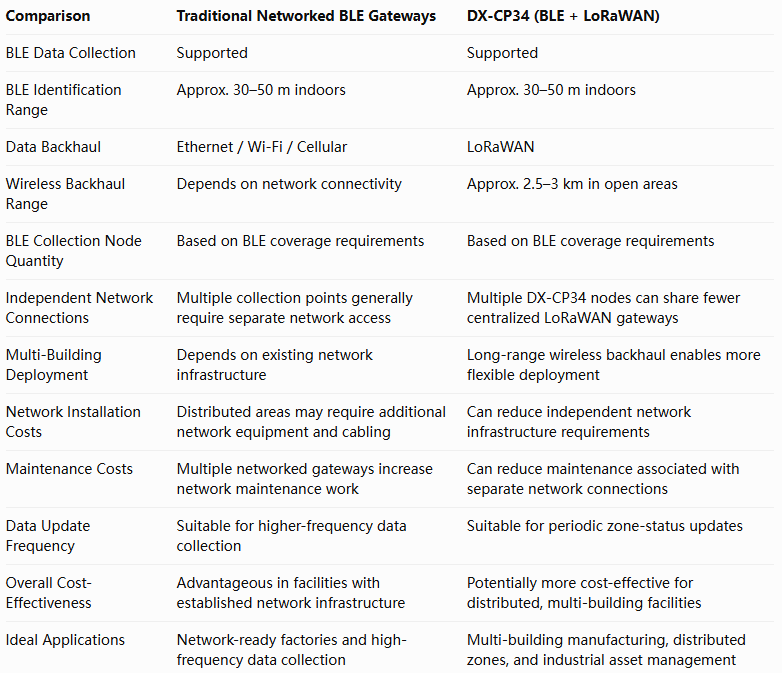
BLE distances are typical indoor planning estimates. Actual wireless coverage, node quantities, and deployment costs depend on
building structures, network conditions, power availability, and data update requirements.
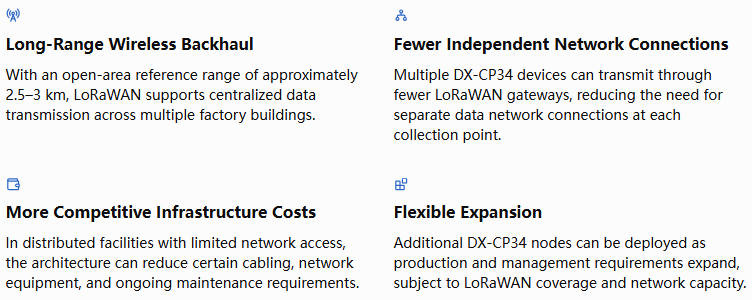
For industrial facilities with multiple buildings and limited network access, BLE + LoRaWAN provides a practical way to improve
deployment flexibility while controlling overall network infrastructure costs.

Conkmile follows a phased engineering approach to help customers plan wireless identification and data backhaul networks
based on their actual industrial environments.
01 · Initial POC Validation
Select representative production or storage areas to evaluate BLE reception between Beacons and DX-CP34 devices,
as well as wireless backhaul performance between DX-CP34 devices and the customer's LoRaWAN gateway.
02 · Communication Configuration and System Integration
Adjust advertising parameters, communication settings, and relevant hardware functions according to project requirements,
then validate integration with the customer's existing gateway and management system.
03 · Multi-Building Deployment Expansion
Plan DX-CP34 collection nodes and LoRaWAN gateway locations based on building layouts, identification zones,
wireless coverage, and data update requirements, gradually establishing a unified wireless data collection network.
Conkmile also provides customization support for selected hardware functions and communication parameters,
helping the devices meet the customer's specific industrial application and system integration requirements.

By combining BLE Beacons with DX-CP34 devices, the customer can consolidate personnel, material, and equipment identification
data from different factory buildings into its existing management platform.
This creates a unified data foundation for manufacturing operations.
By combining BLE Beacons with DX-CP34 devices, the customer can consolidate personnel, material, and equipment identification
data from different factory buildings into its existing management platform.
This creates a unified data foundation for manufacturing operations.
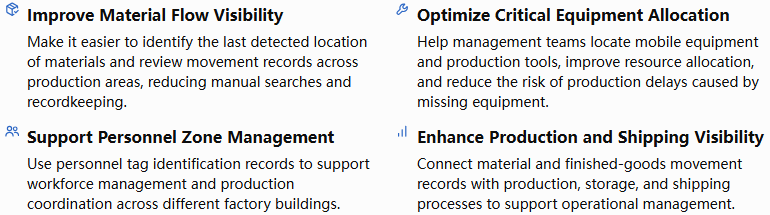
For the customer, the value of this solution goes beyond asset identification.
By using LoRaWAN to consolidate data from distributed production areas, the architecture reduces reliance on independent network
connections at each collection point.
As identification and management requirements grow, the customer can expand BLE Beacon and DX-CP34 deployments within the
coverage and capacity limits of the existing wireless network, continuously improving operational visibility across the industrial facility.

Conkmile specializes in the research, development, and manufacturing of BLE Beacons, LoRaWAN devices, and industrial IoT wireless hardware.
We provide system integrators and industrial customers with flexible, reliable, and integration-ready wireless hardware solutions.
Beyond standard products, Conkmile supports device configuration, protocol integration, hardware function customization, and POC
engineering validation, helping customers integrate wireless identification capabilities into their existing management systems.
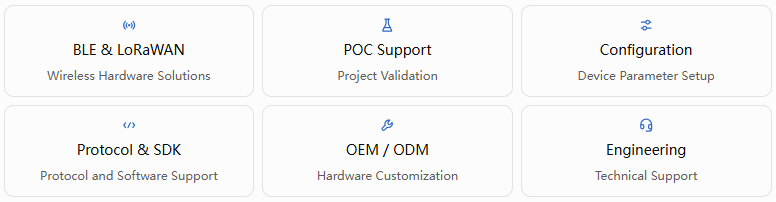
From BLE asset identification in a single factory building to LoRaWAN wireless data backhaul across multiple manufacturing facilities,
Conkmile provides flexible hardware selection, customization, and engineering support to help customers bring industrial IoT projects to life.
BLE Beacons · LoRaWAN + BLE Hardware · POC Support · Protocol Integration · OEM/ODM


